Once the inventors of the world figured out a way to capture man's visage on glass, and later film, the next logical conquest would be to capture sound as well, even though it would nearly a half-century from that time until the two would be successfully joined. The prospect of bringing a full orchestra, band, or even a small recital into one's home, not to mention the profit that could be derived from such an enterprise, certainly drove varying inventors to try to duplicate sound using a semi-permanent archive format. This would eventually become the phonograph.
A replica of Edison's first viable cylinder player.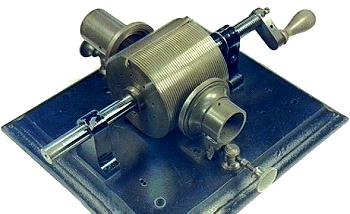 |
The first successful attempts at such a device are generally credited to well-known inventor
Thomas Alva Edison in 1877. Among his original plans for the device were as a dictating device for the office and a reading aid for the blind, similar to the books on tape that are so common now. (This was a follow-up in part to Alexander Graham Bell's efforts to create practical hearing aids for the deaf). The cylinder was the format of choice, originally used for a recording-only device from the late 1850s called the
Phonautograph, invented by
Leon Scott. For many recording purists it might still be considered the best format due to geometric advantages of the cylinder over the disc. The cylinder recording/playback device was a hand cranked unit covered with tin foil, and later used wax cylinders. The advantage to the system was that the needle contacted the surface at the same speed all across the cylinder, and at the same angle, minimizing distortion. A vertical, or hill and dale groove was used for the cylinders, causing the playback stylus to move up and down rather than back and forth. The disadvantages included an initial playing time of around 2 minutes, and some premature wear. The tinfoil was good for only a few plays before it wore down, and the wax had a longer but still limited life. Lower recording speeds yielded longer performances but lower fidelity. Cylinders made of hard wax improved the sound somewhat. At a standard speed of 120 or 160 rpm, the initial two minute limit, later increased to four minutes with some modification of the gearing ratios, was one of the contributing factors to eventual downfall of this format, which lasted around 30 years in commercial production.
Cylinder devices were originally designed to analyze sound or store Morse code signals, and were later promoted as an early form of the office Dictograph. The principle of cylinder recording of music is similar to that later used for discs, and was developed in an effort to augment the practical uses, and therefore sales, of cylinder devices.
A view inside an Edison recording
studio with 13 cylinder machines
set up to capture a performance.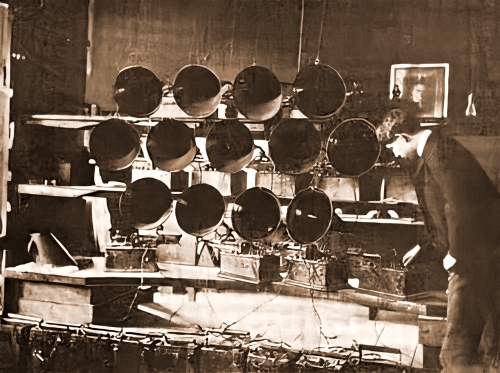 |
A large recording horn was affixed to a diaphragm of glass or thin metal, which in turn was attached to a stylus. When a performer sang or played directly into the recording horn, the diaphragm would vibrate, transmitting those vibrations into the stylus, which would cut into the foil, or later, wax cylinder. The same methodology in the opposite direction was applied to playback.
The recorded frequency response was severely limited due to characteristics of the horn and diaphragm in combination, and this directly affected which instruments could or could not record well onto cylinders.
Among the losers in this regard were stringed instruments and pianos, which would help to account for the large volume of band music that exists on cylinder recordings. Furthermore, since duplication of cylinders was not a reality until 1902 or so, mass duplication of recordings was done by recording several cylinders from several recording horns at one time, a process that required the musicians to repeat their performances many times just to produce an appreciable quantity of cylinders for eventual sale. At 12 to 15 recorded cylinders per take for a band, and maybe 4 to 6 cylinders per take for accompanied singers, the hours spent in a studio were certainly a strain on any musician, and yielded a wide variety of often uneven performances.
Cylinders came in a variety of colors depending on the material used. |
Even different instrumental mixes from the same take could be discerned on multiple cylinders. Duplication was sometimes achieved by running a cylinder player into a tube connected to other recording devices, but the copy of a copy was never as loud or clear as the originals.
The largest and most obvious proponent of cylinder recordings and playback devices was understandably Edison's company, since he had invented and refined the process. Columbia Records, one of the earliest commercial concerns, also supported the cylinder for many years, but encountered some of the same issues early on with wearing out performers in an effort to create an appreciable number of recordings for sale. Once mass duplication was made possible in 1902, it helped to relieve performers and reduce prices for manufacturers. More titles could be recorded in one day as well, keeping up with the demand for variety. But it was more or less too late. The discs were coming to take over from the tenuous cylinder and had already been mass-produced for a number of years with a wider variety of available titles and playback devices.
The inventor credited with refining the process of recording and playback using a flat disc is
Emile Berliner, who released his first phonographs and recordings in 1893 after years of development. Christened as the
Gramophone, it played flat discs of hard rubber and reproduced sound in a similar fashion to the cylinder,
An early horn gramophone.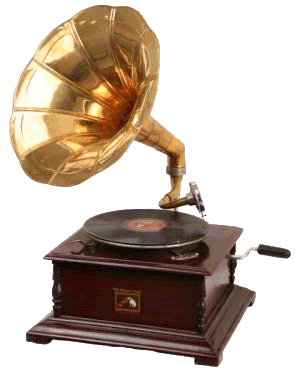 |
where the needle transmitted vibrations in the record groove to a metallic diaphragm, which was in turn amplified through a medium to large horn attached to the tone arm. The first obvious advantage to the format was that one master could be duplicated quickly and many times over in comparison to the cylinder. It also allowed for three and one half minutes of recording time, depending on the rotation speed, and both sides of the disc could be used as well. The disadvantage is that the needle velocity in relation to the groove slowed considerably as the inside of the record was reached, and the angle of the needle also changed, causing poorer sound reproduction during the last minute or so of a recording. Records were cut with the recording stylus moving in a straight line and generally 90° to the center of the disc. The tone arms on the playback machines, however, were on a pivot, and there was often no compensation for the change in angle of the needle to the record, creating premature wear on the discs as well as significant distortion in some cases.
Sales were sluggish at first, in part because of the current success of the cylinder machines, particularly in public where the novelty of playing a recording for a nickel was beneficial to many venues that had them installed as well as enjoyable for the customers. Once Berliner's company found better materials for producing more durable discs, and as a result of the many lawsuits between varying manufacturers which spurred alternate methods of reproduction, creating new patents in the process, the dust finally settled and the disc came out as the format of choice. Adding to the lure was Berliner's determination to record the world's best artists performing the world's best music, which he had done by 1902. The one artist who most codified the disc as the most popular medium was Enrico Caruso. His involvement in recording helped to encourage many other artists to make discs as well.
Just like Henry Ford brought personal transportation to the individual citizen,
Eldridge Johnson did much the same for recorded music. A Camden, New Jersey machine shop owner who had been contracted to build components for Berliner's phonographs, he founded the
Victor Talking Machine Company in 1901. This was in part due to patent violations attributed to Berliner, making it impossible for him to sell his machines in the U.S. for a number of years. Johnson simply bought some of the patents and, with great foresight, the famous
Francis Barraud painting of
His Masters Voice, then started producing disc based phonographs with external horns for table tops.
The author's 1915 Victrola Model VV-X with semi-automatic brake. The record on the turntable is a Brunswick in red shellac.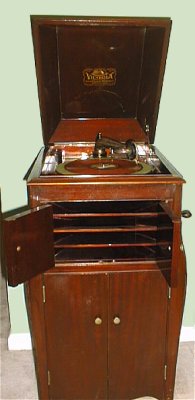 |
It was the Victor company that first experimented successfully in 1905 with the notion of hiding the often unsightly and maligned horn, necessary for sound reproduction, in a cabinet below the phonograph. The end result yielded the
Victrola, a device that not only looked better (albeit at a lower volume), but with the lid shut, could be viewed as an attractive piece of furniture. In fact, a furniture manufacturer was called on to create the cabinets for the first three years from 1906 to 1908. Jobbing out the cabinet kept the price high at first, making the Victrola only available to those with the means to plop down $200 or more, as opposed to the exposed horn models which sold for $100 down to $25.
Johnson had an impressive factory complex built on the site where his original machine shop stood, and created an assembly line for his phonographs that rivaled that of Henry Ford's Dearborn, Michigan, plant for the Model T Ford. Once the Victor company started producing their own cabinets and improved on the overall sound design, mass manufacturing brought the prices down to under $100 for tabletop models with internal horns, later extended to full-sized pieces with internal record storage. Many manufacturers followed suit with the design as quickly as they could, a challenge to them particularly when dealing with possible patent infringements. By 1910, the disc phonograph had taken over the world, and Edison was one of the only companies left producing cylinder recordings for a dwindling market. In 1911, prices dropped even further on Victrolas to as low as $15, causing other manufacturers to scramble to do the same in an effort to compete.
Among the advantages of the cabinet designs that were produced by Victor were improved low tones through better resonance from the wood, the ability to control volume by adjusting the doors or shutters in front of the horn, hiding of the record playing mechanism underneath a domed lid, and media storage built right into the cabinet. As was the trend with pianos of the time, cabinets were also available in a wide range of woods and styles, including Louis XIV, Elizabethan and Victorian motifs. Many were quite elaborate with beautifully carved legs and exquisite engravings rivaling designs of the finest pianos. Other features on more elaborate models included semi-automatic braking of the turntable, and even an electric motor as an alternative to the wind-up spring motor that was the industry standard. Accessories such as tone arm lights and adaptors that allowed the playback of vertically cut Edison discs were also available.
While there were many imitators, Victor set the standard throughout the 1900s to 1920s for the home phonograph. In 1925 they introduced their much anticipated and cleverly advertised Orthophonic system, which utilized improved diaphragm design and advanced horn resonance creating a much more full-bodied sound. It should be noted that this was also the first full year that electronic recording overtook acoustically recorded discs, which was a major advance in the sound, one that could be accurately reflected on an Orthophonic Victrola. However, the advent of electronic recording also made possible electronic reproduction of the records, technology that was itself an offshoot of radio, a medium which was quickly gaining popularity. By necessity, Victor teamed with the burgeoning Radio Corporation of American (RCA) to produce electronically amplified playback machines. In spite of problems with tube amplifiers and inherent distortions not present in horn reproduction, the amplified units did offer better control of volume and some had record changers installed as well. The wind-up acoustic phonograph was relegated to the status of a children's record player soon thereafter. It is perhaps more than a coincidence that Edison sold off all remaining cylinder and disc stock and concerns just one day before the stock market crash of 1929, and that just a couple of months earlier, the Victor Company was acquired in full by RCA, creating RCA Victor, a company that still exists into the 21st century. The Victor part of the name has been dropped from the electronics division, but still exists in the recording arm of the company.
One other notable development was Edison's eventual acceptance of the disc format,
An Edison vertically cut disc of You'd Be Surprised and Sahara, We'll Soon Be Dry Like You both from 1919.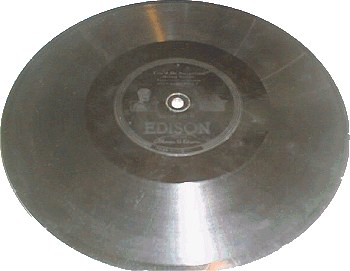 |
and his efforts to improve on it. Starting in 1912, the Edison company produced recordings on a format called
Diamond Disc. These records tended to be thicker than other records, and therefore more durable. The diamond disc groove was recorded vertically (in an up-down pattern) rather than laterally (from side to side) like most other commercial discs (other than those issued by Pathé). As a result of this, they could only be played on Edison phonographs as other disc players would not achieve the same volume and would eventually chew up the records. The same held true for playing other records on an Edison machine. Why Edison stuck with this proprietary format right up through 1929 is a matter of speculation. However, he made it clear that he believed his recording process to be superior to all others of the time. Many public displays were held in large theaters where a singer would start a song, the lights would be put out, and the audience would be asked if they were listening to the singer or a recording of that singer. Most audiences were evidently fooled and convinced of the fidelity of the players, but not induced to invest in them wholesale. Due to the elevated costs of Diamond Discs over all others, as well as the need for an Edison machine to play them and cabinet designs that generally were less appealing, the end result was the public's abandonment of something considered both non-standard and less accessible in terms of recorded media. In addition, adaptors were made available to play Diamond Discs on non-Edison phonographs by simply twisting the playback head 90°. An attempt to produce electronically recorded discs using the lateral groove cutting process came too late to save Edison's phonograph enterprise.
In the age of digital audio and video, most people born from the 1980s on have been subject primarily to cleanly recorded music either nearly or completely devoid of hiss or other noises. Even for those born as early as 1960, they enjoyed relatively high-fidelity music for 20 years and stereophonic or quadraphonic (an early incarnation of surround sound) reproduction, and simply got used to the seemingly subdued level of noise. But for the 70 years leading up to that time, recording engineers and designers were constantly in search of ways to produce music at higher fidelity (literally faithfulness to the original) with minimal noise. This section is just a brief overview of that search, along with minor technical information, some observations, and commentary about the results of these engineers. For a more detailed history, the author highly recommends the latest revision (1994) of
From Tinfoil to Stereo, an interesting look at technical developments and legal struggles to create better recordings.
When Thomas Edison first recited, "Mary had a little lamb...,"
Thomas Edison with one of his early Dictaphone cylinder machines.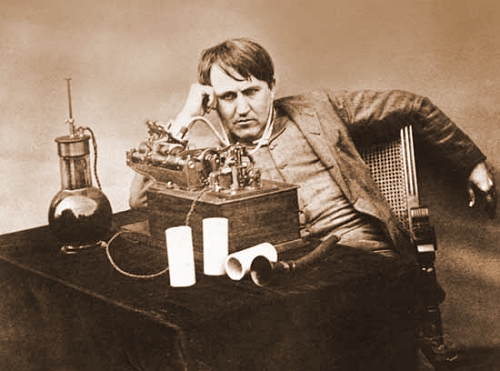 |
into the horn of his cylinder recorder onto a piece of tinfoil, he was using his invention for the purpose it was developed for - as a dictating device. Even though the human voice can cover a wide range of the widely accepted 20-20,000 Hz (alternately cps or cycles per second) frequency spectrum, from low bass notes to the crispest sibilants, the average male or female speaking voice can be captured tolerably well within a very limited portion of that spectrum. So the only fidelity that was necessary was functional. The small horn that Edison used for both recording a playback provided little more than that, covering a range of maybe 400-1,500 Hz. Even that range varied, depending on the speed at which the cylinder was cranked. Edison really did not consider at first the potential viability of his invention as a form of musical archive, and had soon turned his attention to making better light bulbs. But once somebody inevitably
did try to record music on this device, it was obvious that something had to change to accommodate the required wider frequency spectrum for palatable reproduction, at least in the range of about 150-4,000 Hz. Thus was born the recording engineer.
The first technical issue, aside from improving on the materials used for the cylinder which is secondary to reproduction on earlier machines, was how to put larger AND smaller sound waves onto a disc. There were compromises where the recording equipment had to be redesigned to accommodate the instruments, and instrumentation had to be altered to accommodate the recording equipment. Increasing the size of the wooden or stiff fabric recording horn was an easy solution, and horns typically grew to a size of three to six feet in diameter. Since sound waves for the upper octaves are relatively short, but those in the lower parts of the spectrum tend to be longer than three feet, the size of the horn made a difference as to how effectively low frequencies could be captured. If the wave was longer than the diameter of the horn, some level of wave alteration occurred so that only partials of notes from bassoons or tubas were captured, as opposed to their fundamental frequencies, giving them a thin or hollow sound. As for the reception of high frequencies, the recording diaphragm connected to the engraving stylus had to transmit those as well as all the low frequency information, so the grade and thickness of the metal or glass used for the diaphragm often dictated the quality of these frequencies. This was sometimes a difficult prospect if the horn was poorly designed to favor only the lower frequencies.
The shape of the horn also made a difference. As with brass instruments, such as the flugelhorn and trumpet which are similar in size but different in tone, the differences in the bore of the cone can favor certain frequencies while canceling out others. This creates spikes at certain frequency levels, something that can clearly be ascertained on the earliest acoustic recordings up through the early 1910s. Also the shape of the bell at the end of cone, as well as the conical characteristics of the bend at the back of it could effect what sounds were captured and which frequencies rolled off. The total length of the recording horn as well as the placement of the instruments also determined variances in volume between recordings. For example, many Columbia recordings are noticeably more subdued than Victor titles with similar instrumentation, indicating different recording practices between the two companies. In early cylinder recordings, which required instrumentalists or vocalists to perform multiple takes in front of an array of acoustic recording horns, marked differences in volume and instrumental balance can be noted between individual cylinders of the same take, based on the location of the recording horn in relation to another cylinder's horn. The advent of mass production ushered in by the disc recording processes helped to negate these differences.
Due to the limited frequency response of many horn designs, engineers had difficulty in effectively recording certain instruments or voice timbres. They would use varying sizes of horns depending on the source, and could network up to four horns in some cases into one recording lathe sound box,
A Victrola turntable with a speed control located at the lower left corner of the picture, with a practical range of 74 to 82 rpm.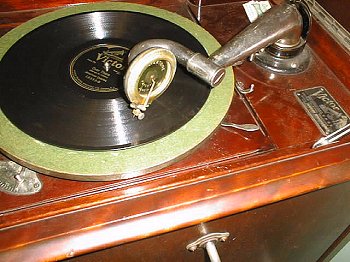 |
effectively an early form of mixing. One of the most obvious instruments that appears only infrequently in the earliest records as a solo instrument is the piano. Most pianos tended to sound rather tubby, favoring the tenor frequencies above all others. Thus there is little recorded piano ragtime or accompanied popular song prior to the early 1910s when many of the spectral problems were countered with new horn shapes and diaphragm improvements. Since sound velocity was the key to creating recordings that would play back at appreciable volumes, many of the early recordings feature brass-based ensembles, since stringed instruments other than the banjo did not transmit nearly as well. Amplifying horns were sometimes attached to violins to even the playing field. In an effort to keep all instrumentalists as close to the recording horns as possible, they were often crowded together on risers with the soloists and softer instruments seated toward the front. This arrangement often meant the audible omission of drums and bass instruments, even though they were at the sessions, but it was necessary due to the limited reception range of the recording horns.
One literal variable that needs to be factored in is that of speed. The earliest cylinders were turned at about 60 rpm (revolutions per minute) and varying recording speeds of 90 to 120+ were used during the 1880s and 1890s until a consistent industry standard of 160 rpm was settled on around 1901. The increase in speed allowed for more accurate cutting of grooves in the cylinder yielding higher fidelity, but shorter playing times. The initial capacity of cylinders was around 120 seconds when cut at 100 grooves per inch, but later technology made a 4 minute cylinder a possibility at 200 grooves per inch, the industry standard until the eventual demise of the format. The change in format also required owners of existing cylinder players to buy conversion gears to properly track the newer cylinders.
Discs went through similar growing pains in regards to speed. Some were recorded at rotation speeds as low as the mid-50s and up into the 90s, making matching of the correct playback speed for the consumer difficult without a pitch reference and knowledge of what key a recording was done in. The eventual industry standard, officially adopted in 1924 but widely used from the mid-1910s forward, became 78 rpm. This yielded a typical practical 3.25 minute limit for 10" discs, one that was extended to 3.5 minutes once electronic recording was applied. 12" discs were capable of 4.75 minutes of material on average. Even after the standard was set,
A 1925 picture showing the difference between acoustic and electric recording layouts, an improvement despite the typical use of only one or two microphones.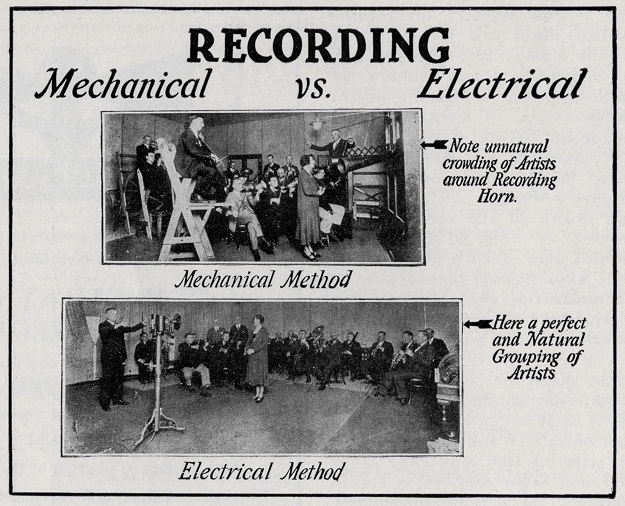 |
some engineers deliberately undercranked recordings to get longer performances on a side, requiring adjustments in speed at the consumer end, or more often an altered performance at 78 rpm playback.
As previously mentioned, the grooves in the majority of commercial discs were cut laterally or from side to side. This meant the louder and lower the frequency, the wider the groove that was needed to properly reproduce it. This has remained true for records throughout the 20th century. But until the engineering was available to control the inward rate of the recording stylus toward the middle of the record, a standard velocity was set that helped to create the approximate time limit, which in part contributed to the length of popular music selections and recordings up through the early 1950s and the advent of the Long Playing disc. But the standard rate for acoustic recording also allowed for a lot of headroom in the recording, and therefore very little distortion from overload, a drawback that was inherent with the advent of electronically recorded discs.
The exceptions to the lateral disc format were Pathé records and Edison's Diamond Disc system. For these, the grooves were cut vertically, or using a hill and dale technique. Since the bulk of stylus travel was absorbed into the depth of these rather thick (1/4" on average) records, the potential for consistent recording time increased to over 5 minutes. However, Diamond Discs were incompatible with systems that played laterally cut discs, and the reverse was also true. The playback stylus for each system was designed only to travel in the direction of the recorded groove, allowing virtually no latitude for grooves cut 90° from what was expected. So while the sound from many Diamond Discs was in many ways superior to both cylinders and standard discs (albeit with increased surface noise), the incompatibility with the format favored by a majority of disc players in the world helped to lead to its demise.
In the mid-1970s just prior to the advent of commercial digital recording, musician and producer
Lincoln Mayorga helped to reintroduce the direct to disc format to the world. Because the negatives (or mothers) used to press production discs were made directly from a pair of masters that were recorded directly from the live input source, bypassing magnetic tape and any electronic processing,
A 1918 Victor record of George M. Cohan's Over There.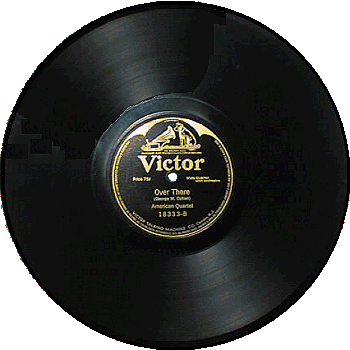 |
the quantity of records that could be made was limited from 10,000 to 100,000 typically, depending on how many masters were pressed, before wear took its toll. The results yielded a presence that could not be experienced on tape, due to phase shifting that occurs at the tape heads, often cancelling out elements that enhance that presence. In an interview with the Los Angeles Times, Mayorga admitted that even in the 1950s and 1960s, he often cut masters for clients onto discs instead of tape because of the end result. Mayorga cited that this is the methodology that was used until the introduction of film recording in the late 1920s, and tape recording after World War II. A careful listen to 78s that were recorded from this time [and it should be pointed out that this means 78s either digitally transferred to CD with minimal processing or played directly on a turntable or acoustic horn player, not those recorded via tape or tape transfer], have a presence that many supposed higher fidelity recordings of the tape era simply do not have. This author would go a step further as to insist that there is an additional presence when playing an old record of Pryor's band or Al Jolson acoustically on a Victrola, as opposed to electronic reproduction of the same recording through the best of modern components. There is a vitality and energy transmitted through that horn which fairly duplicates what was received by the recording horn so many decades past. Lincoln Mayorga was absolutely right, as his direct to disc records had similar energy when played back on equipment that echoed the electronic capabilities of the recording devices. It should also be pointed out that even 16-bit digital formats like Compact Discs, as clean and seemingly flawless as they are, do not provide the same continuous stream of music as does a record groove, because digital sound is a collection of on and off signals while sound from the groove is "always on."
So every bit as much as color process photography (Autochromes) from the early 1900s gives us a glimpse into that time with more depth than monochrome images, the acoustic recordings, as limited as they may be in frequency range, are still a valuable aural window into the studio on the day they were recorded. If you have a collection of records from before 1930, a Victrola or similar playback device would be highly recommended in order to attain the ambience of that time. A warning should be inserted here that most records made from the mid-1930s on will not stand up well under the weight of a gramophone needle. It should also be made clear that your needle should be changed after each record, and at the very least after each two sides played. Follow these rules and you may be amazed at how vital these "relics" could sound. There are still lots of Victrolas and their cousins out there, and certainly a large wealth of material to play on them, maybe even at grandpa and grandma's house.
Listen. Explore. Discover. Collect. Most importantly, Enjoy!






 Loading Page. Please Wait...

 Player Pianos
 Phonographs and Recording







 Click here for more space
  Click here to expand menu